
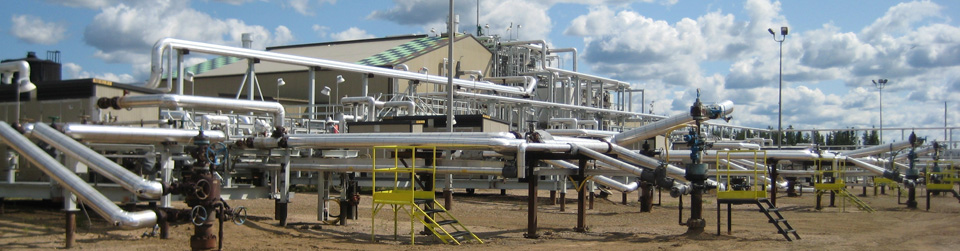
Attributes of the Alberta Oil Sands Heavy Oil Project
Attributes Of Project
The project is a heavy-oil production, upgrading and development opportunity in Alberta's oil sands. Its defining attribute is configuration rather than location: steam-assisted gravity drainage and upgrading are developed as one integrated facility, because that integration is what overcomes the three economic hurdles of SAGD bitumen production.
Production attribute: thermal recovery
Bitumen is recovered by steam-assisted gravity drainage, the established thermal method for resources too deep for surface mining. SAGD performance is governed by the steam-to-oil ratio, and every unit of steam not required is a unit of natural gas not purchased. Production is therefore designed around steam efficiency first and throughput second.
Upgrading attribute: product quality at the wellsite
Upgrading sits inside the project boundary rather than being contracted downstream. That converts raw bitumen into a stream meeting pipeline specification without purchased condensate, removing diluent cost and the discount blended bitumen attracts in the market. Revenue is then tied to the quality of what the project makes.
Utility attribute: energy and water reuse
Heat recovery and produced-water recycling are treated as design parameters, not compliance add-ons. The integrated configuration allows energy and water reuse at the lowest environmental footprint, with upgrader heat and off-gas available to the steam plant and a shared water circuit serving both halves of the complex. The result is lower purchased energy, lower make-up water demand and a smaller environmental envelope than two separate facilities would require.
Development attributes
- Jurisdiction: Alberta, Canada, a mature regulatory and service environment for oil-sands development.
- Resource: heavy oil and bitumen suited to in-situ thermal recovery.
- Configuration: SAGD production integrated with on-site upgrading.
- Economic basis: displacement of purchased natural gas and elimination of bought-in diluent.
- Environmental basis: energy and water reuse at the lowest environmental footprint.
How the attributes are verified
Each attribute above is a testable engineering claim. Feasibility studies establish the energy and mass balance, plant design and engineering fix the configuration, energy and waste audits quantify the reuse case, and independent due diligence confirms the result before turn-key execution.
Why configuration outranks location
Alberta's oil sands contain more viable resource than there are viable projects, and the difference is usually the operating model rather than the geology. Two developments drawing on comparable bitumen can return very different netbacks depending on how steam is generated, whether diluent is purchased, and whether heat and water leave the site as waste or return as feed.
Risk attributes acknowledged openly
Integration couples two plants with their own availability profiles, so turnaround planning, redundancy and start-up sequencing carry more weight than in a stand-alone scheme. Those are engineering problems with known answers, addressed during design rather than discovered at commissioning.
Learn More:
An oil sands project defined by its configuration
SAGD production integrated with on-site upgrading removes diluent cost and displaces purchased natural gas in Alberta's oil sands.
Klean Industries supplies the feasibility studies, plant design and engineering, and turn-key DBC and EPC delivery used to verify and build that configuration.
Want the full technical attributes of the project walked through?
Contact Klean Industries about the Alberta oil sands heavy oil project » GO.